By the end of this post, you’ll be able to read an FR garment label, understand exactly what each code protects against, and make procurement decisions that could save a life on the floor.
Technical White Paper: The Professional’s Guide to EN ISO 11612 (2025–2026) Industrial Safety Standards
1. Introduction: The Landscape of Industrial Thermal Protection
In the high-stakes environment of industrial risk management, EN ISO 11612:2015/2025 stands as the definitive international benchmark for heat and flame-resistant (FR) protective clothing. For the Industrial Safety Compliance Engineer, this standard is not merely a checklist but a technical framework for mitigating life-threatening thermal energy transfer. The core mission of EN ISO 11612 is to provide a calibrated defence against short-term exposure to flame, radiant heat, and molten metal splashes.
From a procurement and risk-mitigation perspective, the certification is mandatory across several critical sectors:
- Oil & Gas: Protects personnel on drilling platforms and in refineries against flash fire risks; necessitates integration with anti-static standards to prevent ignition sources.
- Metallurgy & Foundries: Defends against extreme radiant heat and massive molten metal splashes near furnaces and pouring stations.
- Utilities & Power: Provides a primary ignition-resistant layer; often paired with electric arc protection for comprehensive electrical safety.
- Manufacturing: Safeguards workers in high-temperature environments, such as glass production and cement kilns, where sparks and thermal contact are routine hazards.
2. The Physics of the Second-Degree Burn Threshold
The engineering rationale behind EN ISO 11612 is the quantification of “Escape Time”—the critical window a worker has to retreat from a thermal event before sustaining irreversible tissue damage. The standard utilises the Heat Transfer Index (HTI 24) and Radiant Heat Transfer Index (RHTI 24) as its primary performance metrics.
The technical threshold for these indices is a temperature rise of ΔT = 24 °C on the skin-side of the fabric. This specific delta represents the physiological limit at which human skin sustains second-degree burns. By measuring the time (in seconds) required for thermal energy to cross this threshold, the standard allows safety officers to conduct site-specific risk assessments based on the predicted duration of potential thermal exposure.
3. Modular Performance Breakdown: Codes A through F
EN ISO 11612 utilises a modular classification system. Compliance requires a pass in the mandatory baseline (Code A) and at least one additional thermal hazard category (B–F).
Table 1: Summary of Performance Modules (2025–2026)
| Performance Code | Hazard Category | Test Standard | Level Classifications |
|---|---|---|---|
| Code A | Limited Flame Spread | ISO 15025 | A1 (Surface) or A2 (Edge) |
| Code B | Convective Heat | ISO 9151 | B1 – B3 (Time to reach ΔT = 24 °C) |
| Code C | Radiant Heat | ISO 6942 | C1 – C4 (Time to reach ΔT = 24 °C) |
| Code D | Molten Aluminium Splash | ISO 9185 | D1 – D3 (Mass of metal to deform PVC) |
| Code E | Molten Iron Splash | ISO 9185 | E1 – E3 (Mass of metal to deform PVC) |
| Code F | Contact Heat | ISO 12127-1 | F1 – F3 (Threshold time at 250 °C) |
Code A: Limited Flame Spread (The Mandatory Baseline)
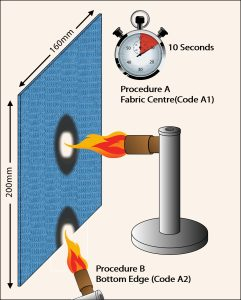
Code A evaluates the self-extinguishing properties of the textile. Testing involves a 10-second vertical flame application where the material must show no melting, dripping, or hole formation.
- A1 (Surface Ignition): Flame is applied to the fabric surface.
- A2 (Edge Ignition): Flame is applied to the bottom edge.
- Engineering Requirement: For maximum site versatility, procurement specifications should mandate A1+A2 to ensure protection regardless of the orientation of the ignition source.
Codes B & C: Convective vs. Radiant Heat
These modules measure the insulation efficiency against different heat transfer mechanisms:
- Convective Heat (B): Measured via open flame exposure. Level B1 represents 4.0 to <10.0 seconds, while B3 represents ≥ 20.0 seconds of protection.
- Radiant Heat (C): Measured via infrared heat flux. Levels range from C1 (7.0 to <20.0 seconds) to C4 (≥ 95.0 seconds). C4 typically requires specialised aluminised coatings to reflect high-density infrared energy.
Codes D & E: Molten Metal Resistance
These tests measure the mass (grams) of molten metal required to cause deformation or melting of a PVC simulated skin membrane placed behind the fabric. The PVC membrane mimics the sensitivity of human skin; any deformation indicates that the threshold for a second-degree burn has been reached.
- Code D (Aluminium): Ranges from D1 (100 g) to D3 (≥ 350 g).
- Code E (Iron): Ranges from E1 (60 g) to E3 (≥ 200 g).
Code F: Contact Heat
This evaluates accidental contact with objects at 250 °C. Level F1 provides a threshold time of 5.0 to <10.0 seconds before a 10 °C temperature rise occurs on the reverse side, while F3 requires ≥ 15.0 seconds.
4. Woven vs. Knitted Structural Dynamics
A significant technical distinction in the 2025–2026 landscape is the engineering trade-off between woven and knitted structures.
- Woven Fabrics (Orthogonal Interlacing): Characterised by warp and weft yarns interlaced at right angles. This produces high tensile and tear strength, making wovens ideal for outer shells, coveralls, and environments where mechanical abrasion is high.
- Knitted Fabrics (Intermeshing Loops): Composed of yarn loops that provide high elasticity and recovery. These are primarily used for next-to-skin layers and polo shirts to reduce ergonomic strain.
⚠ Safety Warning: While knits offer superior flexibility, their intermeshing loop structure inherently creates larger pores than woven fabrics. These pores can permit hot gases to penetrate the fabric more easily. Furthermore, knitted structures are prone to wet-thermal shrinkage during laundering, which reduces air and water vapour permeability over time, potentially increasing the wearer’s heat stress even if FR properties remain intact.
5. Structural Design Requirements for Certified Garments
Performance is not limited to fabric chemistry; garment architecture must prevent “heat entrapment.” Every design element — from pocket flaps to trouser cuffs — plays a direct role in worker survival.
- Pocket Flap Integrity: All external pockets must feature flaps that exceed the opening by at least 20 mm to prevent the ingress of sparks or molten metal.
- Closure Systems: Metal zippers, buttons, or snaps must be covered by protective fabric flaps to prevent convective heat transfer to the skin.
- Limb Protection: Trousers are forbidden from having turn-ups (cuffs), which act as collection points for molten splashes or flammable contaminants.
- Ergonomic Overlap: Two-piece suits must maintain a minimum overlap of 20 cm between the jacket and trousers during all physical movements (bending, kneeling) to ensure the torso is never exposed.
6. Comparative Analysis: International Standard Mapping
EN ISO 11612 vs. NFPA 2112
| Feature | EN ISO 11612 (International) | NFPA 2112 (North America) |
|---|---|---|
| Logic | Modular Grading (A–F) | Pass/Fail System |
| Mannequin Test | Optional (ISO 13506) | Mandatory (ASTM F1930) |
| Washing Cycles | Tested after 5 or 50 cycles | Tested after 100 industrial washes |
| Durability | Heightened 2025 stringency | Long-term laundering focus |
EN ISO 11612 vs. EN ISO 11611 (Welding)
While 11612 is a general-purpose standard, 11611 is for specialised welding environments. Key differences:
- Molten Splash: 11612 focuses on large molten splashes (Codes D/E), whereas 11611 tests for “small spatter” impact.
- Electrical Insulation: 11611 requires a mandatory resistance of > 105 Ω at 100 V DC, specifically intended to protect against accidental electrical shock. This does not replace specialised high-voltage insulation gear.
7. Material Science: Inherent vs. Chemically Treated Fabrics
Technical Categorisation
- Inherent FR: Protection is integrated into the molecular structure (Aramids, Modacrylics, FR Viscose). They form a charred carbonaceous barrier upon exposure and do not melt.
- Chemically Treated FR: Cotton/Polyester blends treated with Proban or Pyrovatex. While cost-effective and comfortable, they typically degrade after certain washes.
Experimental Blends and High-Value Insights
Recent technical evaluations have identified cost-effective experimental blends that challenge the dominance of pure Aramids. The VNM523 (Stellhartt’s Sort # XT9261 blend (50% FR Viscose / 20% Nylon 66 / 30% Modacrylic) has demonstrated the ability to pass EN ISO 11612 even after 50 wash cycles — proving that safety performance can be achieved by engineering a modacrylic matrix with cost-effective fibres like nylon and viscose.
Table 2: Commercial Landscape (2025–2026 Market Leaders)
| Fabric Name | Structure | Composition | Weight (gsm) | Key Certifications |
|---|---|---|---|---|
| iFRMCA | Woven | 55% Modacrylic, 32% Cotton, 7% FR PA, 8% Para-Aramid, 1% AS | 255 | 11612 (A1+A2, B1, C1, E3, F1), 11611 |
| Tr-185AS | Woven | 80% Cotton, 19% Polyester, 1% Antistatic | 185 | 11612, 1149, 20471 |
| FR-Jersey-200C | Knitted | 60% Modacrylic, 38% Cotton, 2% Antistatic | 200 | 11612, 1149-3, 61482-2 |
| iFR-270 | Woven | 58% Modacrylic, 30% Cotton, 5% Para-Aramid, 2% AS | 270 | 11612, 11611, 61482-2 |
8. Advanced Innovations and the Future of PPE
The frontier of FR textile research is rapidly evolving. From aerogel-infused laminates to bio-sourced coatings and sensor-embedded smart fabrics, the next generation of PPE promises lighter, smarter, and more durable protection.
- Silica Aerogel Lamination: New coatings containing 45 wt% silica aerogel provide extremely low thermal conductivity, achieving Class 1 ratings for both contact and radiant heat without the bulk of traditional insulation.
- Bio-Based FR Coatings: A shift toward “Layer-by-Layer (LbL) self-assembled coatings” utilising Phytic Acid (plant-derived) and Polyethyleneimine (PEI) to replace halogenated retardants.
- Smart Textiles: Integration of Clay-based Janus micro-nanosystems and piezoresistive sensors that provide active fire warnings, triggering alerts when ambient temperatures exceed safety thresholds.
9. Maintenance, Care, and Operational Lifespan
Proper maintenance is inseparable from protection. A certified garment that is incorrectly laundered, contaminated, or repaired with non-FR materials can fail catastrophically in a thermal event.
- Laundry Parameters: Effective decontamination requires industrial laundering at 60 °C to 75 °C.
- Contamination Risk: Accumulation of oils, grease, or solvents can ignite on the surface, bypassing FR properties and causing “wicking” fire spread.
- Repair Protocols: All repairs must utilise FR-rated sewing threads (e.g., XM-60/70). Use of standard polyester thread creates a “fusible link” that will fail during a flash fire.
- Decommissioning: Garments must be removed from service if they exceed their certified wash cycle count or show physical degradation that compromises the thermal barrier.
10. Technical FAQ
- Does EN ISO 11612 cover Arc Flash?
- No. Arc Flash protection requires certification under IEC 61482-2.
- Can EN ISO 11612 gear be used for structural firefighting?
- No. Structural firefighting requires EN 469 certified gear. EN ISO 11612 is designed for industrial heat, not fire entry or structural suppression.
- What is the significance of A1 vs. A2?
- A1 signifies surface ignition protection; A2 signifies edge ignition protection. Procurement should prioritise A1+A2 for comprehensive safety coverage.
11. Conclusion: Strategic Procurement Recommendations
Strategic procurement in 2025–2026 must move toward multi-risk integration. Selecting fabrics based on cost alone ignores the life-cycle value of inherent fibres and the protective superiority of multi-norm garments (EN ISO 11612 combined with EN 1149-5 and EN ISO 20471).
Safety officers should prioritise material durability and the “escape time” metrics provided by performance codes over the lowest initial bid — to ensure regulatory compliance and, ultimately, worker survival.